Search


Winning Customers

Competitive Strategy


Differentiating Ideas and Strategies

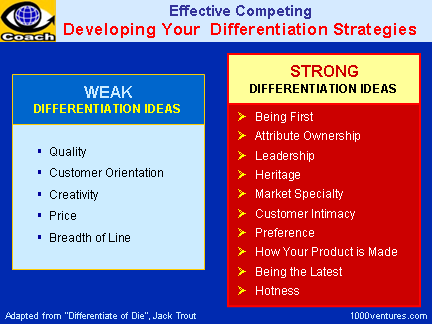
Strong vs. Weak Differentiation Strategies  ●  3 Parts of Your Differentiation Strategy


Adapted from books by Jack Trout, Steve Rivkin and Al Ries


Competitive Strategy Differentiation Strategies Ten3 Business e-Coach: why, what, and how 22 Laws of Marketing: LEADERSHIP 22 Laws of Marketing: ATTRIBUTES Moving with Speed Customer Intimacy Quality Management Creativity Effective Pricing Customer Care

Three Parts of Your Differentiation Strategy2

Positioning: Have a simple idea that separates you from your competition  >>>

Trust Building: Have the credentials or the product/service that makes this concept real and believable

Awareness Creation: Build a program to make your customers and prospects aware of this difference


Four Steps of Your Differentiation Strategy1

Make Sense in the Context of the Category
Your message has to start with what the marketplace has heard and registered from your competition – get a quick snapshot of the perceptions that exist in mind, not deep thoughts...
More

Differentiation Strategy

4 Steps    Differentiating With Different Types of People

Brand Management

Advantages of Strong Brands    Brand Equity

Name    Great Slogan    Logo Design

Strategic Brand Management

Competing

Stand Out from the Competition >> 3 Strategies

Sustainable Competitive Advantage

Your Competing Skills    Competitive War Games

Competitive Strategy

Marketing Strategy

22 Immutable Laws of Marketing >> Leadership Category

Creative Marketing

Positioning

KoRe 10 Tips

10 Commandments

Winning and Retaining Customers

Winning Customers

Customer Value Proposition    Unique Selling Proposition (UPS)

Enterprise Strategy

Blue Ocean Strategy    Venture Strategies

Opportunity-driven Business Development

Fast Company >> Fast To Market

Your People Skills

How Our Mind Works    Mental Maps    Connecting with People

Cultural Intelligence

Managing Cross-cultural Differences


Best Practices and Success Stories

Differentiation

Logo of Ten3 Business e-Coach

CimJoy >> CimJoy Guiding Principles

Brand Management

Asian Home Gourmet    Coway Doongjin

Marketing Secrets of the Rich Dad Brand

Customer Value Creation

Emotional Marketing

Amazon    Coco Chanel    Estee Lauder    Half.com    Unisys


Differentiating Idea

Your differentiating idea is your competitive mental angle.3

Competitive angle
Your differentiating idea must have a competitive angle to have a chance for success. Your product or service must be, first, different, and second, competitive in the total marketing arena.

Mental angle
The marketing battle takes place in in the mind of the prospect. It is the
perception that must be considered in the selection of an idea, not the reality. Competitors that do not exist in the mind can be ignored. Competitors who enjoy strong perceptions that do not agree with reality must be evaluated based on these perceptions, not the reality.


Why Differentiate?

Differentiation is the key to building and maintaining your sustainable competitive advantage. A superior product or service means nothing without a way of somehow letting your prospective customers know about it. The concept of being unique or different is far more important today than it was ten years ago. The key to successful marketing and competing is differentiation.

Hypercompetition and over-communication are key features of new economy. What used to be national markets with local companies competing for business has become a global market with everyone competing for everyone's business everywhere. With the enormous competition markets today are driven by choice – your targeted customers have too many choices, all of which can be fulfilled instantly.

 Thus, "differentiation is one of the most important strategic and tactical activities in which companies must constantly engage. It is not discretionary".1

Harnessing the Power of Psychology

You don't need a degree in psychology to compete successfully in the marketplace, but you do need some way to figure out the different styles of interaction different people prefer to use.

People tend to lead their decision-making process decisions with one of the four functions: intuition, thinking, feeling, and sensing. Vividly differentiated differences that are anchored to a product and engage the above functions can enhance memory of your current and prospective customers... More


References:

Differentiate or Die, Jack Trout with Steve Rivkin    The Power of Simplicity, Jack Trout with Steve Rivkin    The 22 Immutable Laws of Marketing, Al Ries & Jack Trout.