| |
|
Quasi-intelligence
(QI) refers to systems or processes that exhibit
intelligence-like behaviors without full
autonomy or consciousness.
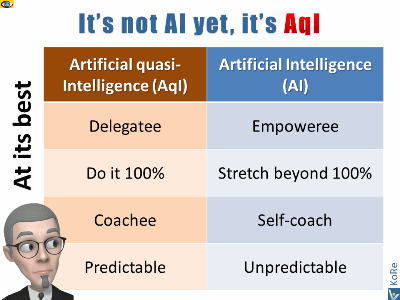
Artificial Quasi Intelligence (AqI)
refers to systems that mimic
intelligent behavior – such as
perception,
prediction, and
decision-making – without
possessing full autonomy or
consciousness.
Unlike artificial general
intelligence (AI),
QI focuses on task-specific,
context-aware functions, often
leveraging AI-driven sensors and
real-time data processing. These
systems deliver actionable
insights by analyzing live
physical-world data, enhancing
efficiency and safety without
requiring human-level cognition.
|
|
|
| |
|
In
KoRe terms, Quasi
Intelligence is what happens
when a mind operates on patterns
instead of principles, on memory
instead of meaning, on reaction
instead of reflection.
When the mind echoes patterns,
it sounds wise;
when it senses essence, it
becomes
wise.
~
KoRe proverb
|
|
|
| |
|
Executive Summary
Quasi Intelligence is the
appearance of intelligence
without its deeper substance. It
is the capacity to produce
correct‑looking answers,
clever‑sounding statements, or
seemingly insightful actions
that simulate wisdom while
lacking the underlying structure
of true understanding.
In
the KoRe framework, Quasi
Intelligence is a crucial
concept because it helps
leaders, educators, and creators
distinguish between signal and
noise, insight and imitation,
growth and stagnation.
Quasi Intelligence is not "fake
intelligence." It is partial
intelligence—a surface‑level
competence that can be useful,
but becomes dangerous when
mistaken for full cognitive
mastery.
|
|
|
| |
|
The Essence of Quasi
Intelligence
|
|
|
| |
Quasi
Intelligence emerges when a system –
human, organizational, or technological
– produces outputs that look intelligent
but are not grounded in:
▪ Deep
comprehension
▪ Contextual
awareness
▪ Purpose
alignment
▪ Adaptive
reasoning
▪
Virtuous‑spiral growth
|
|
 |
| |
|
It is intelligence without
interiority.
A performance without backstage.
A map without terrain.
|
|
|
| |
|
Three Core Characteristics
①
Pattern Fluency Without
Conceptual Depth: Quasi
Intelligence can mimic expertise
by repeating familiar structures
– phrases, formulas, frameworks
– yet it cannot generate new
structures. It is fluent but not
fertile.
②
Confidence Without
Calibration: It often speaks
with certainty because it cannot
feel the boundaries of its own
ignorance. True intelligence
senses its limits; quasi
intelligence does not.
③
Action Without Awareness:
It can execute tasks, follow
rules, and produce outputs, but
it cannot evaluate whether those
outputs serve the system’s
purpose or elevate the virtuous
spiral.
|
|
|
| |
|
Why Quasi Intelligence Matters
In
the KoRe worldview, the future
belongs to systems and
individuals who can discern
intelligence from quasi
intelligence. This discernment
is now a strategic skill.
▪
In leadership, it
prevents shallow
decision‑making.
▪
In
education, it prevents
memorization from masquerading
as mastery.
▪
In
technology, it prevents
automation from being mistaken
for wisdom.
▪
In
personal growth, it
prevents ego from confusing
performance with progress.
Quasi Intelligence is a mirror
that reveals where a system is
performing intelligence instead
of developing intelligence.
|
|
|
| |
|
The KoRe Distinction
KoRe e-Coach defines
intelligence as the ability
to
see,
sense,
and
shape
the system. Quasiintelligence
can see patterns, but cannot
sense essence or shape
direction.
True intelligence is
generative.
Quasi Intelligence is
imitative.
True intelligence is
meta-aware.
Quasi Intelligence is
context‑blind.
True intelligence
expands the virtuous spiral.
Quasi Intelligence circles
inside the same loop.
|
|
|
| |
|
The Strategic Value of
Recognizing Quasi Intelligence
When you can identify Quasi
Intelligence, you gain three
advantages:
▪
You stop overestimating shallow
signals.
▪
You start investing in deeper
cognitive development.
▪
You build systems that reward
genuine insight rather than
polished imitation.
Quasi Intelligence is not the
enemy of intelligence. It is the
threshold – the place where
intelligence begins.
|
|
|
| |
|
How to use this information
|
|
|
| |
|
①
"Adapt what is useful, reject
what is useless, and add what is
specifically your own."
~
Bruce Lee
②
Sleep on this information – your
powerful
superconscious mind will
tell you how to use it when you
wake up
|
|
 |
|
|