|
AABI - Asian Association
of Business Incubators
  

The Asian Association of Business Incubation (AABI) +
Growth Ecosystem
The Asian Association of Business Incubation (AABI) is a
multilateral network fostering innovation and
entrepreneurship across the Asia-Pacific region.
It supports business incubation by enabling
collaboration, knowledge sharing, and strategic
partnerships among incubators, startups, and
stakeholders.
***VK
***
I played a role in the
establishment of AABI while working at the UN Asian and
Pacific Centre for Transfer of Technology (APCTT) from
1990 to 2004. As the leader of a regional UN project (METI)
– designed by Rustam Lalkaka, one of AABI’s founders – I
helped develop a network of technology business
incubators across Asia that laid the foundation for AABI.
Following this extensive, long-term preparatory work,
AABI was officially established in 2002.
Now, 24 years later, together with a group of
international partners, I am preparing to take my
association with AABI to a new level. We have created a
next-generation business incubator, Newdutek, for formal
entry into AABI. In collaboration with several
international partners who are AABI members, we are
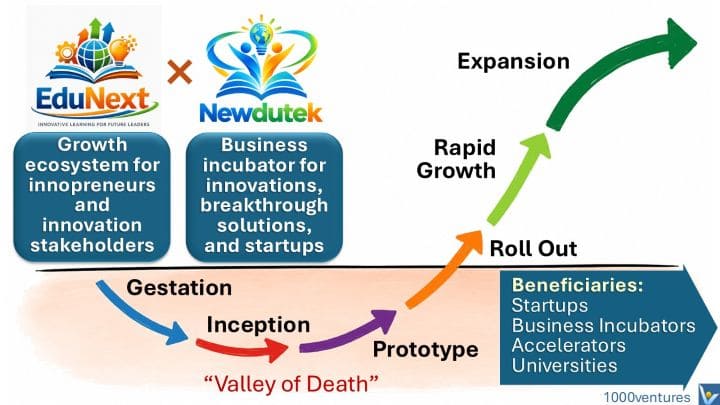
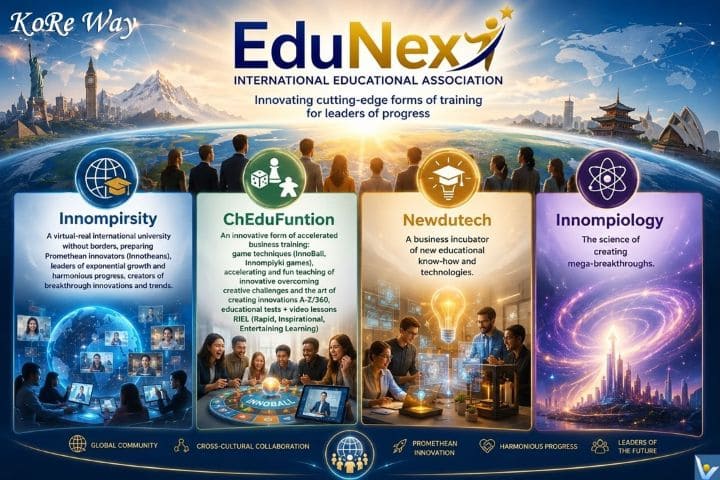
launching the EduNext accelerated growth ecosystem. The
lead partner is Dr.
Rajendra Jagdale, co-founder of AABI, ISBA, and
World
Innompic Games.
Here is a brief overview of AABI and growth ecosystems.
***
AABI promotes best practices in incubation through
events, awards like the Incubator & Torch Entrepreneur
Awards, and regional capacity-building initiatives. Its
mission emphasizes sustainable economic development by
empowering early-stage ventures and strengthening local
ecosystems.
The Asian Association of Business Incubation (AABI) is a
major non-profit multilateral network founded in 2002 to
support innovation, technology transfer, and
entrepreneurship across the Asia-Pacific region.
Key Overview
Founding: Established on April 30, 2002, expanding
across 19+ countries and regions (including China,
India, South Korea, Thailand, and Australia).
Mission: Promote business incubation activities by
facilitating cross-border resource sharing, knowledge
exchange, and strategic alliances among incubators and
tech startups.
Scope: Connects with over 5,000 technology incubators,
positioning itself as a leading business incubation
network in the Asia-Pacific.
Core Activities & Programs
AABI Incubator & Torch Entrepreneur Awards: Annual
awards recognizing excellence among regional startup
incubators and outstanding internationalized portfolio
companies.
International Workshop on Business Incubation (IBI):
Regular training programs and workshops designed for
incubator managers, policymakers, and investors.
Publications: Launches initiatives like the Asia-Pacific
Journal of Innovation and Entrepreneurship (APJIE) to
cover academic and practical research on incubation
ecosystems.
Experts Missions & Cross-Border Camps: Hosts regional
dialogues, joint acceleration programs (such as
Sino-Thai camps), and delegation missions to connect
local ecosystems globally.
| |
Growth Ecosystem
A
growth ecosystem is a dynamic
network of interconnected
stakeholders – users, builders,
partners, and platforms – that
collectively drive sustainable
expansion. By fostering
collaboration, shared value, and
mutual alignment, such
ecosystems enable scalable
growth.
Ecosystem-Led Growth (ELG)
leverages partner networks as
the core strategy for customer
acquisition and retention,
turning relationships into
growth engines. Success hinges
on creating an environment where
participants are incentivized to
contribute, innovate, and stay
engaged over time.
|
|
 |
| |
Talking with another founder who
has already dealt with a similar
challenge can shorten the
learning curve.
Their experience
may not provide an exact
solution, but it can reveal
risks, alternatives, and
considerations that might
otherwise be overlooked.
This is where founder-to-founder
conversations become
particularly useful.
Instead of relying only on
books, podcasts, consultants, or
online advice, entrepreneurs can
learn directly from people
actively building businesses
themselves.
|
|
|

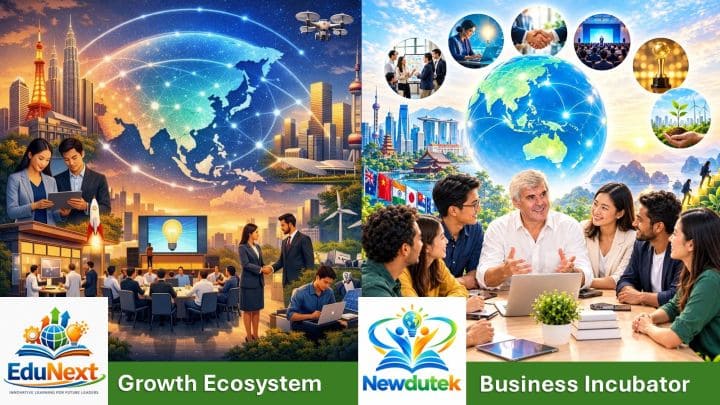
A growth ecosystem for innovation
stakeholders fosters collaboration among
key players – such as universities,
industry, government, startups, and
investors – to drive technological
advancement and solve complex
challenges. These ecosystems thrive on
interconnectedness, shared resources,
and open communication, enabling rapid
ideation, prototyping, and scaling of
innovations. Success depends on active
participation, trust, and aligned
incentives across diverse actors. Such
environments not only accelerate
innovation but also enhance economic
resilience and competitiveness by
integrating research, funding, policy,
and market access.
A growth ecosystem for innovation
stakeholders is a collaborative network
where entrepreneurs, investors,
universities, corporations, and
governments interact to co-create value
and scale new technologies.
A growth ecosystem is an interconnected
network of businesses, partners,
technologies, or regional stakeholders
that collaborate to multiply value and
accelerate sustainable scaling.
Core Concepts of Growth Ecosystems
Ecosystem-Led Growth (ELG): A business strategy where
companies use partner networks, integrations, and shared
data – rather than traditional sales alone – to drive
customer acquisition, retention, and expansion.
Startup & Tech Ecosystems: Regional hubs comprising
hundreds of startups, investors, and universities
working together to transition from emerging hubs into
global leaders.
Economic & Business Networks: Structured communities
(such as entrepreneurial or innovation networks) that
supercharge labor productivity and resource efficiency.
Why Growth Ecosystems Matter
Faster Go-To-Market: Leveraging partner channels
shortens sales cycles and increases win rates through
warm introductions.
Built-in Trust: Collaborating with trusted industry
influencers or complementary platforms bypasses the
friction of cold outreach.
Shared Resilience: Interconnected networks adapt better
to market shifts by pooling resources, data, and
innovative capabilities.
*** ELG ***
Ecosystem-Led Growth (ELG) is a go-to-market strategy
where a business leverages its network of partners –
including software integrations, channel partners,
agencies, and influencers – to source, influence, and
accelerate revenue. Rather than relying solely on
traditional, isolated sales and marketing channels, ELG
treats the company's partner network as the primary
mechanism for sustainable scaling.
|