| |
FutureStep
A strategic
management process for navigating complexity and
generating innovation
* * *
A modular tool -
its parts can be used independently or as a
complete program |
|
 |
| |
|
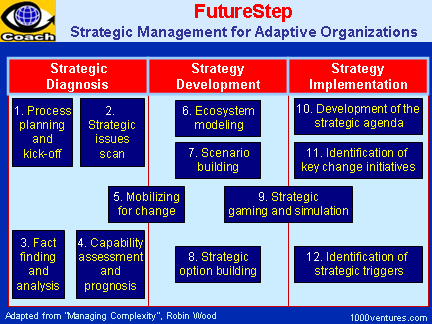
FutureStep is a
strategic management process
that helps companies, especially
large multinational adaptive
organizations, integrate
flexibility and responsiveness
into every aspect of their
activities.
FutureStep helps both
concentrate on the future and
live in the present. It is a
modular tool, and parts can be
used independently or as a
complete program for guiding
strategic decision making.
The FutureStep process is aimed
at enabling organizations to
meet the challenges of
navigating a complex and
uncertain future environment, by
helping them to evolve as
complex, intelligence systems.
It focuses on what an
organization can do in the
present to increase its ability
to operate in a sustainable way
in the future.
|
|
|
| |
|
Benefits
Enjoyed by Organizations
Practicing FutureStep
Enhanced organizational
intelligence, shown by
improved decision quality and
accelerated learning capability.
Greater clarity and
robustness in strategic
direction, with reduced risk;
Increased adaptiveness, speed
and flexibility in
responding appropriately to
change;
Improved organizational
design in which the shape or
form of the organization mirrors
its function and embodies its
own transformational
capabilities;
Stakeholder alignment
around a shared, sustainable
model of the
business ecosystem with
which the organization
co-evolves.
|
|
|
| |
|
AI-driven forecasting is applied across various domains:
Supply Chain: Predicting disruptions and optimizing
logistics.
Finance: Stress-testing portfolios and projecting
earnings.
Human Resources: Forecasting staffing needs and employee
turnover.
Sales: Forecasting demand and competition...
More
|
|
|
| |
|
Background
This approach to strategic
management evolved through many
years of practical experience
with multinational organizations
in several industries in Europe,
North America and Asia.
Organizations that have
pioneered this kind of approach
to strategic management include
3M, British Telecom (BT), the
British National Health Service,
Dutch Telecom, Hewlett-Packard,
Jardine Matheson, Shell, State
Farm Insurance, and the US
Department of Defense.
*
* *
"In the case of complex adaptive
systems, their schemata have
consequences in the real world,
which exert selection pressures
back on the competition among
the schemata, and those schemata
that produce favorable results
in the real world have a
tendency to survive, or be
promoted, and those that are
less successful in the real
world have a tendency to be
demoted or disappear. In many
situations, complexity may offer
a selective advantage."
~
Murray Gell-Mann
|
|
|
|
|