 |
|
"Five whys cut through
confusion like a sharp blade – only the essence
remains."
~
KoRe Japanese-style proverb
* * *
Are you solving problems or
juggling symptoms?
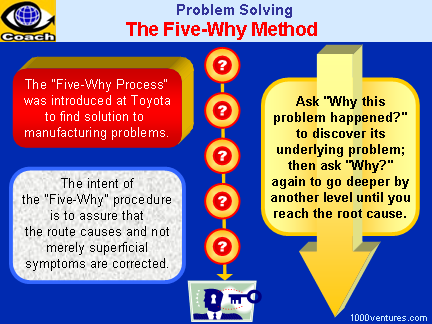
Ask "Why this problem happened?" to discover its underlying problem; then
ask "Why?" again to go deeper by another level until you reach the root
cause.
Asking "why" repeatedly, possibly more than
five times, directs the focus toward real causes so
problems can be solved
permanently.
|
|
|
5 Whys
Method – culture-toned KoRe
proverbs |
| |
|
"A problem well stated is a problem half
solved."
~ John Dewey
|
|
|
| |
The Five Whys is a simple but great
technique to use to
solve problems. It is a question-asking method used to explore
the cause/effect relationships underlying a particular problem
systematically.
Ultimately, the goal of applying the 5 Whys method is to determine a
root cause of a defect or a problem.
|
 |
| |
|
"When a company forgets to
sharpen its tools, even the
finest workshop falls silent."
~
KoRe proverb
|
|
|
 |
|
The architect of the Toyota Production System, Taiichi Ohno, described the 5 whys method as "the basis of
Toyota's scientific approach . . . by repeating why five times, the nature
of the problem as well as its solution becomes clear." The tool has seen
widespread use beyond Toyota,
and is now used within
Kaizen,
lean manufacturing, and
Six Sigma. The 5 Whys really gets people involved using their brains and
challenging the 'status quo.'
* * *
"He who asks a
question may be a fool for five minutes, but he who never
asks a question remains a fool forever."
~ Tom Connelly |
|
|
Listen to small
warning signals to prevent minor issues from
escalating into serious problems.
~
KoRe proverb |
| |
Kaikaku and the Five-Why Technique
"Ask "Why" five times," advises Hiroyuki Hirano
in his "10 Kaikaku Commandments“
that provide a roadmap for radical
improvements.
Norman Bodek, a
Lean Manufacturing
guru, writes in his comments to the 10 commandments, "In the mid-nineteen
eighties I took Dr. Shingo to Granville-Phillips a manufacturer of vacuum
testing equipment in Boulder, Colorado. Granville-Phillips had brilliant
engineers, but they took four months to bring a new product to market (and
then the result was 97% defects in final inspection). Dr. Bills, the CEO of
Granville-Phillips, asked Dr. Shingo to please look at their manufacturing
process to see if he could help them become more efficient. Shingo at first
went to where the process originated. We went to watch the design engineers
and then we followed a logical progression through the entire manufacturing
process. At each stage engineers and managers would present problems to Dr.
Shingo and he would carefully think and look and then instead of just giving
the answer, he would ask the engineers some very basic questions. He loved
to use the Five Whys, asking why five times.”
|
|
Problem Solving
4 Levels
6 Steps
American vs. Russian Approach
STRIDES Model
GE Work-Out
Creative Problem Solving (CPS)
Challenge Assumptions
Break Rules<
Questions for Creative Problem Solving
Turn Problems to Opportunities
'Why? What If?' Questions
Examples
|
|
 |
The release of
atomic energy has not created a new problem. It
has merely made more urgent the necessity of
solving an
existing one. |
Albert
Einstein |
| |
|
Joke: It only took one question "Why?"
to get to the root of the problem
The mother-in-law
arrives home from shopping to find her son-in-law,
Paddy in a steaming rage and hurriedly packing his
suitcase.
"What happened Paddy?"
she asks anxiously.
|
|
|
|
 |
| |
Solve a problem
and you'll be successful for a day.
Become a Great
Problem Solver and you'll be successful for your
lifetime!
|
|
 |
|
|