| |
|
360-degree Assessment is a
multi-rater assessment by
supervisors, peers,
subordinates, and customers.
|
|
|
 |
|
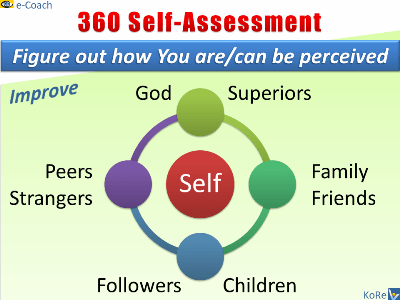
Action-oriented
360 Self-Assessment
The two main benefits of
360 self-assessment
are:
①
Better self-awareness
②
Self-improvement |
|
|
 |
| |
|
360-Degree Employee Evaluation
Getting feedback and appraisals
from supervisors, peers,
subordinates, customers
|
|
|
|
|
|
The
360-degree assessments are commonly used in
corporations in management and
leadership development programs. In
360-degree assessment, the participant completes
a self-assessment and also collects feedback
from supervisors, peers, subordinates and
customer (or sometimes vendors).
Benefits
of 360-Degree Assessment
The
360 feedback gives employees a deep
understanding of their strengths and areas to
develop. The advantage of 360-degree assessments
is that you are able to compare your
self-perceptions with feedback that shows how
others – supervisors, peers, subordinates and
customers –
perceive you.
Studies show that work performance improves when
people receive 360-degree assessment feedback,
and learning-type individuals who have the
greatest skill or personality deficits benefit
the most.
Two Kinds of 360-Degree Assessments
Personality Assessment: HOW you do things;
measures character and personality traits
Competency Assessment: WHAT you do; measures
discrete, work-related skills such as planning,
organizing, staff development, teamwork, or
performance
feedback.
|
|
|
|